 Travis County Birding
Birding Travis County: a beginner's guide
Everything you need for your first season.
Travis County sits where two Texases meet. West of I-35 is the Hill Country: limestone, juniper and oak, clear creeks and canyon walls. East of it the land flattens into Blackland Prairie, river bottoms and farm ponds. Add the Colorado River, a chain of lakes, and a spot right on the Central Flyway, and you get one of the birdiest counties in the state: more than 430 species have been recorded here.
You don't need to know any of them to start. This guide covers the gear and apps worth having, the birds you'll meet first, the local specialties people travel for, what each season brings, and a handful of easy places to go.
Getting started
- Binoculars
- Any pair beats none. If you're buying, 8×42 is the all-round size: bright, steady and a wide view. Good beginner pairs start around $150. Free walks (below) often lend binoculars, so you can try before you buy.
- Merlin, on your phone
- Cornell Lab's free Merlin app identifies birds from a photo, a few questions, or by listening: hold your phone up in the morning and it names the singers around you. It's the fastest teacher there is.
- eBird
- Also free from Cornell Lab: a log of what you saw, where and when. Your checklists help science (and this site, which is built entirely from public eBird checklists), and eBird shows what's been seen at any spot recently.
- A field guide
- A paper guide teaches you how birds are related and what to look at. Central Texas falls in the 'Eastern' guides: Sibley's Eastern guide, Kaufman's Field Guide to Birds of North America, or Peterson's.
- Go early, go slow
- Birds are most active in the first two or three hours after sunrise, and in summer that's also the only bearable time. Walk slowly, stop often, and look at every level: the ground, trunks, the canopy and the sky.
- Go with people
- Birding with others is the quickest way to learn. Travis Audubon runs free walks and classes (including Birding 101), and Austin Public Library branches host free Beginner Birding Walk & Talks with Travis Audubon leaders. Hornsby Bend has a monthly bird survey anyone can join.
Twelve birds to learn first
All here year-round, and most will turn up in a yard or neighborhood park.
- Northern CardinalJFMAMJJASOND
Red male, brown female, both crested with a thick red-orange bill. Whistled 'cheer, cheer, cheer.'
- Black-crested TitmouseJFMAMJJASOND
Small grey bird with a black crest: a Texas specialty that's an everyday yard bird here. Sings 'peter-peter-peter.'
- Carolina ChickadeeJFMAMJJASOND
Black cap and bib, white cheeks. Often travels with titmice; scolds 'chick-a-dee-dee-dee.'
- Carolina WrenJFMAMJJASOND
Warm brown with a bold white eyebrow and a huge voice: 'tea-kettle, tea-kettle.'
- Northern MockingbirdJFMAMJJASOND
Grey with a long tail and white wing flashes. Copies every sound around it, sometimes all night in spring.
- Great-tailed GrackleJFMAMJJASOND
Glossy black males with long, keel-shaped tails; smaller brown females. Owns every parking lot.
- White-winged DoveJFMAMJJASOND
Austin's most common dove: a white stripe on the wing and a 'who-cooks-for-you' coo.
- Lesser GoldfinchJFMAMJJASOND
Tiny yellow-and-black finch with white wing patches. Comes to sunflower and thistle seed.
- Eastern PhoebeJFMAMJJASOND
Plain grey-brown flycatcher that pumps its tail and says its name. Likes bridges, eaves and creeks.
- Red-shouldered HawkJFMAMJJASOND
The neighborhood hawk: barred orange breast, checkered wings and a loud, repeated 'kee-ah.'
- Black VultureJFMAMJJASOND
Black with white wingtips and a short tail, soaring in groups. Turkey Vultures (red heads, longer tails) join them.
Local specialties
The birds that make birding here different from anywhere else.
- Golden-cheeked WarblerJFMAMJJASOND
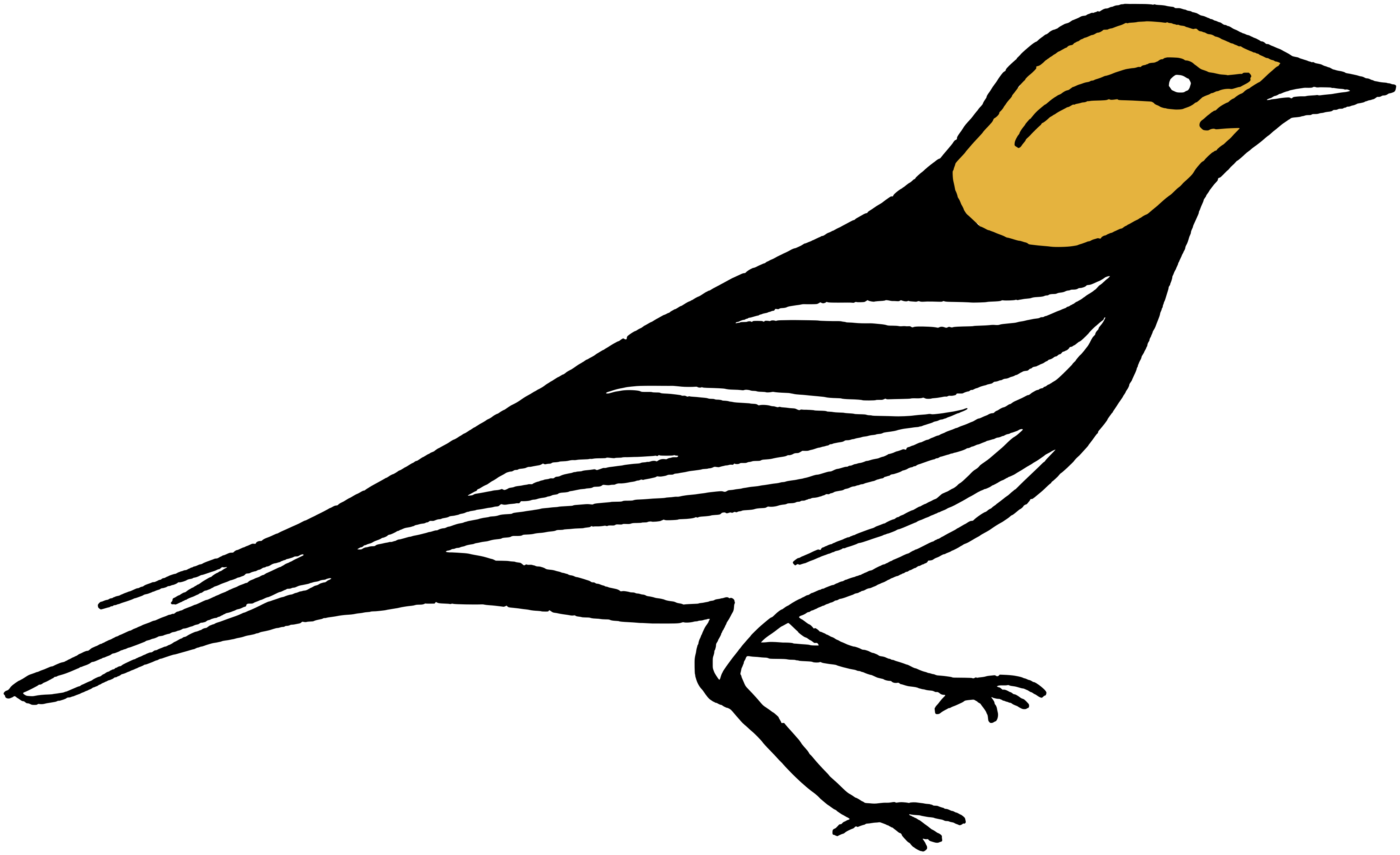
The only bird that nests nowhere but Texas, in old Hill Country juniper-oak woods. Arrives in early March and sings through May; mostly gone by mid-July. Endangered: stay on the trail and skip the playback. Warbler Vista at Balcones Canyonlands is the classic spot.
- Black-capped VireoJFMAMJJASOND
Endangered songbird of low, shrubby oak scrub. Scarce in Travis County itself; Balcones Canyonlands' Doeskin Ranch, just over the line in Burnet County, is the reliable place to hear one.
- Painted BuntingJFMAMJJASOND
Blue head, red belly, green back, and a lime-green female. Sings from brushy edges and fence lines all summer: Commons Ford and Hornsby Bend are good bets.
- Golden-fronted WoodpeckerJFMAMJJASOND
Zebra-backed woodpecker with a golden nape. Most reliable in the hills west of Austin; only an occasional visitor in the city.
- Canyon WrenJFMAMJJASOND
Lives on limestone cliffs. Listen for its song, a run of sweet notes that tumbles downhill, echoing off canyon walls at Pace Bend, Hamilton Pool and the greenbelts.
- Monk ParakeetJFMAMJJASOND
Escaped pets that went wild here in the 1970s. They build bulky stick nests on stadium and utility light towers; look around Lady Bird Lake and Hyde Park.
- Purple MartinJFMAMJJASOND
Our biggest swallow, back at backyard martin houses by mid-February. From mid-July to early August, huge flocks gather at an evening roost (lately in Round Rock, just north of the county) and Travis Audubon hosts 'Purple Martin parties' to watch them come in.
- Chimney SwiftJFMAMJJASOND
Cigar-shaped birds twittering over town all summer. They nest in chimneys and in the swift towers Austinites have built for them.
- Scissor-tailed FlycatcherJFMAMJJASOND
Pale grey with salmon flanks and an absurdly long forked tail, on fences and wires across the eastern half of the county.
The seasons
Something is always arriving or leaving.
Spring March–May
Golden-cheeked Warblers arrive in the first days of March, and the Hill Country fills with song. Migration peaks from late April into early May, when warblers, vireos, orioles and tanagers pass through any patch of trees on their way north. Small green spaces with water, like Mills Pond and Laguna Gloria, can be packed on a good morning.
- Nashville WarblerJFMAMJJASOND
Grey head, white eye-ring, yellow below: the most common migrant warbler here, spring and fall.
- Black-chinned HummingbirdJFMAMJJASOND
The summer hummingbird at Austin feeders; males flash a violet band under a black chin.
- DickcisselJFMAMJJASOND
Like a tiny meadowlark: yellow breast, black bib. Sings its name from prairie fields from April.
Summer June–August
It's hot. Go at first light and plan to be done by ten. Painted Buntings and Dickcissels sing from fields and fence lines, Scissor-tailed Flycatchers sit on every wire, and nighthawks call over town at dusk. In late July the Purple Martin roost puts on the best bird show of the year.
Fall September–November
Migration runs the other way, slower and longer. Hummingbird numbers peak in mid-September, shorebirds stop at Hornsby Bend's ponds, and warblers trickle through until the first cold fronts. By late October the winter birds are back: sparrows, kinglets and Yellow-rumped Warblers everywhere.
- Ruby-throated HummingbirdJFMAMJJASOND
Passes through in spring and, in bigger numbers, from August to early October. Keep feeders up.
Winter December–February
Winter is the easiest season to start. Leaves are down, birds flock together, and the heat is gone. Ducks fill Hornsby Bend and Walter E. Long Lake, American White Pelicans and Bald Eagles visit the lakes, sparrows work the fields at Commons Ford and Webberville, and Sandhill Cranes pass overhead, bugling.
- Yellow-rumped WarblerJFMAMJJASOND
The winter warbler: brownish with a bright yellow rump and a sharp 'chek' call. In every tree.
- Ruby-crowned KingletJFMAMJJASOND
Tiny olive bird that flicks its wings nonstop; the ruby crown is usually hidden.
- Cedar WaxwingJFMAMJJASOND
Sleek, crested and masked, in wheezing flocks that strip berry trees. Peaks in March.
- White-crowned SparrowJFMAMJJASOND
Bold black-and-white striped head; the easiest winter sparrow to learn.
- Northern ShovelerJFMAMJJASOND
A duck with an oversized, spoon-shaped bill. Often the commonest duck at Hornsby Bend.
- Sandhill CraneJFMAMJJASOND
Usually heard before seen: rolling, bugling calls from high V's passing over in fall and late winter.
Where to go
Eight places to start, easiest first.
- 1
Mueller: Southwest Greenway and Mueller LakeBest: Year-round
The easiest place to start: flat, paved and in the middle of town. Walk the whole length of the Southwest Greenway; its gardens, ponds and lawns each hold different birds, and the lake adds ducks and herons.
Free, with street parking.
- 2
Roy G. Guerrero Colorado River Metro ParkBest: Year-round; migrants in spring and fall
A big riverside park about ten minutes from downtown. Bird the Bluff Trail and follow it down to Secret Beach on the Colorado River: woods, river edge and open sky in one walk.
Free.
- 3
Mills Pond at Wells BranchBest: April–May
If you're up north: a small pond and easy loop trail, known for spring warblers.
Free neighborhood park.
- 4
Commons Ford Ranch Metro ParkBest: Year-round
A West Austin park on Lake Austin with restored prairie (managed with Travis Audubon's help), woods and a lakeshore. Drive all the way to the back of the park. Grassland birds and buntings in summer, sparrows in winter.
Free. Open 5 am–10 pm.
- 5
Hornsby BendBest: Year-round; best in fall, winter and spring
This is where the real birding is. Austin's biosolids treatment ponds aren't scenic and don't smell great, but they're the county's top site, with 360+ species: ducks in winter, shorebirds in spring and fall, and river woods for migrants. Bird the pond levees on foot or slowly by car.
Free. Daylight hours; check in at the gate (bring ID). Summer mosquitoes are fierce. The City of Austin hosts a monthly bird survey on the second Saturday at 7 am.
- 6
Balcones Canyonlands NWR: Warbler VistaBest: March–June
A federal wildlife refuge in the western hills, and the place to hear Golden-cheeked Warblers. Short trails through juniper-oak woods to a long view of the hills.
Free. Open daily, about 6 am–10 pm as of fall 2026; stay on the trails.
- 7
McKinney Falls State ParkBest: Year-round
More scenic than birdy: Onion Creek, limestone ledges and pecan bottoms in southeast Austin. A lovely walk that turns up the common woodland birds.
State park day-use fee (Texas State Parks Pass covers it).
- 8
Walter E. Long LakeBest: November–March
A big lake on the east side for winter ducks, gulls and Forster's Terns, with reed beds for marsh birds. A spotting scope helps.
Day-use fee at the park entrance.
Hours and fees change; check the park's own site before a first visit.
Find your people
- Travis Audubon
- The local birding society: free bird walks, Birding 101 classes, field trips, sanctuaries (Baker Sanctuary, Blair Woods, Chaetura Canyon) and the Purple Martin parties. Membership opens the members-only sanctuaries.
- Austin Public Library walks
- Free Beginner Birding Walk & Talks at branch libraries, led by Travis Audubon birders. Binoculars are often available to borrow if you arrive early.
- Hornsby Bend bird survey
- The City of Austin's Center for Environmental Research hosts a monthly survey at Hornsby Bend that anyone can join.
- Christmas Bird Count
- Every December, teams count every bird in a 15-mile circle in one day. Beginners are welcome on a team with experienced counters.
Staying comfortable and safe
- Heat
- From May to September, go at dawn, carry more water than you think you need, and wear a hat. Afternoon birding in August is no fun for you or the birds.
- Bugs and plants
- Ticks and chiggers live in tall grass (tuck pants into socks, use repellent); fire ant mounds are everywhere; learn poison ivy's three leaves.
- Snakes
- Rattlesnakes and copperheads are around, mostly in warm months. Watch where you step and put your hands, and stop walking before you raise your binoculars.
- Water
- Creeks and low-water crossings flood fast after storms. Never wade or drive into moving water.
Good birding manners
- Stay on the trail
- Especially in the Golden-cheeked Warbler and Black-capped Vireo preserves, where habitat is the whole point.
- Give nests and roosts room
- If a bird is scolding you or won't leave a spot, you're too close. Back off and watch from farther away.
- Go easy on playback
- Playing songs to draw birds out stresses them, especially in nesting season. Don't use it on endangered species, and follow park rules.
- Be careful with locations
- Share rare birds on eBird, but keep owls, active nests and anything on private land to yourself.
- Log what you see
- Submit eBird checklists. They make the science better, and they're what this site runs on.
Ready? See what's being seen today or what to look for this week. Spot something wrong in this guide? Let us know.