Loading species…
Where it's been seen
Hotspots with reports in the last 30 days.
Loading recent sightings…
Loading this year…
Loading history…
 Travis County Birding
Search species and hotspots
Loading species…
Hotspots with reports in the last 30 days.
Loading recent sightings…
Loading this year…
Loading history…
Waterfowl and waterbirdsDucks, Geese, and Waterfowl
Dendrocygna bicolor


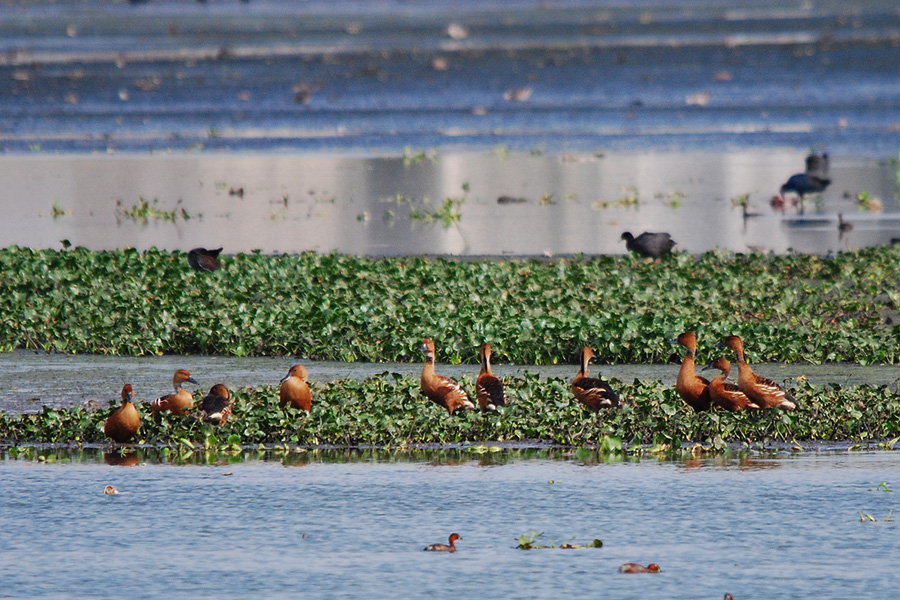

The fulvous whistling duck or fulvous tree duck is a species of whistling duck that breeds across the world's tropical regions in much of Mexico and South America, the West Indies, the southern United States, sub-Saharan Africa and the Indian subcontinent. It has plumage that is mainly reddish brown, long legs and a long grey bill, and shows a distinctive white band across its black tail in flight. Like other members of its ancient lineage, it has a whistling call which is given in flight or on the ground. Its preferred habitat consists of wetlands with plentiful vegetation, including shallow lakes and paddy fields. The nest, built from plant material and unlined, is placed among dense vegetation or in a tree hole. The typical clutch is around ten whitish eggs. The breeding adults, which pair for life, take turns to incubate, and the eggs hatch in 24–29 days. The downy grey ducklings leave the nest within a day or so of hatching, but the parents continue to protect them until they fledge around nine weeks later.
Read more on WikipediaNot reported in Travis County in the last 30 days
Winter visitor · usually early–mid Mar and Apr–May and early–mid Jul and Dec–Feb
| Week | Checklists reporting it |
|---|---|
| Jan 1–7 | 0.8% |
| Jan 8–14 | 0.4% |
| Jan 15–21 | 0.2% |
| Jan 22–end | 0.2% |
| Feb 1–7 | 0% |
| Feb 8–14 | 0% |
| Feb 15–21 | 0% |
| Feb 22–end | 0% |
| Mar 1–7 | 0% |
| Mar 8–14 | 0.2% |
| Mar 15–21 | 0% |
| Mar 22–end | 0% |
| Apr 1–7 | 0% |
| Apr 8–14 | <0.1% |
| Apr 15–21 | 0% |
| Apr 22–end | 0.2% |
| May 1–7 | 0% |
| May 8–14 | 0% |
| May 15–21 | 0% |
| May 22–end | 0% |
| Jun 1–7 | 0% |
| Jun 8–14 | <0.1% |
| Jun 15–21 | 0% |
| Jun 22–end | 0% |
| Jul 1–7 | 0% |
| Jul 8–14 | 0.5% |
| Jul 15–21 | <0.1% |
| Jul 22–end | 0% |
| Aug 1–7 | 0% |
| Aug 8–14 | 0% |
| Aug 15–21 | 0% |
| Aug 22–end | 0% |
| Sep 1–7 | 0% |
| Sep 8–14 | 0% |
| Sep 15–21 | 0% |
| Sep 22–end | 0% |
| Oct 1–7 | 0% |
| Oct 8–14 | 0% |
| Oct 15–21 | 0% |
| Oct 22–end (now) | 0% |
| Nov 1–7 | <0.1% |
| Nov 8–14 | 0% |
| Nov 15–21 | <0.1% |
| Nov 22–end | 0% |
| Dec 1–7 | 0% |
| Dec 8–14 | 0% |
| Dec 15–21 | 0.2% |
| Dec 22–end | 0.3% |
Share of complete checklists at each hotspot that reported it (2016–2026). Hotspots with fewer than 15 checklists are left out, and the order discounts small samples, so a hotspot with few checklists can sit below one with a lower share.
From the eBird Basic Dataset (Sep-2026), complete checklists only.
From every checklist reported in the county this year: who found it first, who finds it most, and when.
Share of 2026 checklists started in each hour that reported it. Hours with fewer than 30 checklists are left out.
| Start time | Share reporting it | Details |
|---|---|---|
| 5 AM | 0% | 0 of 79 checklists |
| 6 AM | 0.1% | 1 of 919 checklists |
| 7 AM | 0% | 1 of 4,912 checklists |
| 8 AM | 0% | 1 of 4,609 checklists |
| 9 AM | 0.1% | 2 of 3,424 checklists |
| 10 AM | 0% | 0 of 2,792 checklists |
| 11 AM | 0.1% | 2 of 2,244 checklists |
| 12 PM | 0% | 0 of 1,944 checklists |
| 1 PM | 0.1% | 1 of 1,517 checklists |
| 2 PM | 0% | 0 of 1,354 checklists |
| 3 PM | 0% | 0 of 1,374 checklists |
| 4 PM | 0.3% | 4 of 1,544 checklists |
| 5 PM | 0.1% | 1 of 1,625 checklists |
| 6 PM | 0.1% | 1 of 1,471 checklists |
| 7 PM | 0.3% | 4 of 1,232 checklists |
| 8 PM | 0% | 0 of 497 checklists |
| 9 PM | 0% | 0 of 118 checklists |
| 10 PM | 0% | 0 of 66 checklists |
| 11 PM | 0% | 0 of 41 checklists |